How to make your next trip more meaningful

How to make your next trip more meaningful
Arriving somewhere new is the easy part. Staying present, curious and open once you’re there is where the real practice begins. Here’s how to make the most of every day once you’ve landed.
Travelling with intention begins before you leave home, with the questions you ask yourself, the research you do differently, and the mindset you pack alongside everything else. If you haven’t read our guide to planning a more intentional trip, it’s a good place to start.
But the real practice begins the moment you arrive.
Because travel has a way of sweeping you up, with the newness of everything, the logistics, the sheer sensory volume of an unfamiliar place. It’s exhilarating. And it’s also how the best intentions dissolve.
This guide is about staying purposeful and intentional: how to slow down, stay curious, and be genuinely present in the places you’ve gone to so much trouble to reach.
Revisit your intentions every day
While you are on your trip, develop a simple daily practice of returning to those intentions you developed before you left.
Not in a rigid, box-ticking way, but as a gentle moment of recalibration. I find that bookending the days works well. A few minutes in the morning to set the tone, and a few minutes in the evening to reflect on what the day offered.
In the morning, read back your intention and orient yourself before the day takes over. Ask the question: what might today hold that speaks to this longing?
In the evening, your journal becomes your companion. There’s real pleasure in documenting what you saw and did. The meal that surprised you, the street you stumbled into, the connection you won’t forget.
Don’t skip that. But don’t stop there either.
Let the documenting be a warm-up for the deeper noticing. What moved or inspired you? Where did you feel most present, most alive, most like yourself? Where did you feel yourself pulling back and slipping into ‘default mode’? These aren’t questions that need long answers. Just a few sentences each evening builds something valuable over the course of a trip: a record of what the journey is actually doing to you, beneath the surface.
Over time, this daily rhythm does something else too. It makes you a more attentive traveller, to the world around you, and also to your own inner landscape. And that, ultimately, is what travelling with intention is really about.


How you move through the world
It’s easy to fall into the trap of thinking we are being intentional by landing in a new city with a list of seventeen things to see, and a colour-coded itinerary for the optimum time to see it. But then by day three you’re exhausted, frazzled, and wondering why you didn’t feel anything when you stood in front of one of the greatest works of art ever created, for example.
The bucket list approach to travel isn’t wrong exactly. But it’s optimised for coverage rather than experience. And travelling with intention asks for something different.
Go slow. Do less.
The single most effective thing you can do to deepen a travel experience is to slow down. Stay longer in fewer places. Linger over a coffee instead of moving on to the next sight. Return to the same café twice. Walk the same street at different times of day. When you stop rushing, the place starts to reveal itself: its rhythms, its textures, its unexpected corners.
Doing less also creates space for the unplanned, and some of the most meaningful travel moments are the ones that weren’t on the itinerary. The conversation with a stranger that goes somewhere real. The market you wandered into by accident. The view you found because you took a wrong turn.
These things just won’t happen when every hour is accounted for.
Cultivate curiosity
When travelling, it’s easy to slip into a mental habit of approaching everything with the impulse to evaluate, find the best angle for a photograph, and move on. It’s a KPI* way of travelling. The metric is “see all the Instagrammable sights and get all the same shots everyone else has taken.” And like most KPIs, it can easily become completely disconnected from the true purpose of the whole project.
When you notice yourself sliding into KPI mode, try this: take a slow breath and remind yourself that curiosity is your real mission here.
Instead of deciding quickly whether something is interesting or photogenic, stay with it a little longer. Ask questions, of locals, of other travellers, of guides, of yourself. What is this place? What happened here? Who made this, and why, and how? Curiosity is a practice, and like most practices, it gets easier the more you do it.
* KPI = Key Performance Indicator: a corporate metric used to measure whether a project or team is hitting its targets. If you’ve never heard of it before, count yourself lucky!
Cultivate wonder
Wonder is closely related to curiosity but distinct from it. Curiosity wants to understand. Wonder is content simply to be astonished. It’s the feeling of standing somewhere ancient and vast and letting the scale of it wash over you without immediately reaching for your phone. It’s noticing the quality of light at a particular hour, or the way a city smells after rain, or the fact that the tree you’re standing under was already ancient when the Romans built their roads.
Wonder is available everywhere, at every budget and in every destination. It just requires you to slow down enough to notice it, and to resist the urge to immediately document, caption, and share it. Let yourself be moved first. The photo can wait.
Mindfulness and awareness
You don’t need a meditation practice to travel mindfully, though if you have one, this is a wonderful time to deepen it. Mindful travel simply means being present to what’s actually in front of you rather than mentally composing your Instagram reel, replaying a conversation from home, or planning tomorrow’s itinerary while today is still happening.
Here’s a simple practice to try. At least twice a day, find somewhere to sit for five minutes: a bench, some steps, a café chair. And then just notice.
What can you hear? What does the air feel like? What are people doing? How are they interacting with each other? Without getting too woo-woo, what’s the energy of this place?
No phone, no agenda. Just attention. It sounds almost embarrassingly simple, and it is. But practice it a couple of times a day and something will shift. Once this happens, you’ll start noticing the details and feelings that stay with you long after you come home.


How you engage with the place
Intentional travel isn’t just an inner journey. It also changes the way you show up in the places you visit, and the relationship you have with the people who live there.
The tourist trail exists for good reasons. The famous sites are famous because they’re genuinely extraordinary, and there’s nothing wrong with visiting them. But if meaningful travel is what you’re after, it’s worth looking beyond the well-worn path. It’s an irony that the most resonant experiences are often found where fewer people think to look.
Seek out the real over the curated
The difference between a tourist experience and a genuine one is often simply a matter of a little extra research and a willingness to venture slightly off the obvious route.
Look for tours and experiences run by local operators rather than international companies. Seek out the neighbourhood market rather than the tourist market, the trattoria where people actually eat rather than the restaurant with the laminated English menu outside.
My absolute favourite is to spend a bit of time in a supermarket. Not a tourist shop, but the kind of place where the locals do their weekly shop. Go in with a mission: find some local-brand chocolate, biscuits, cheese, or whatever you treat yourself to at home. What you find will probably be completely different from what you expected. Embrace that difference.
These aren’t just more interesting experiences, they’re more honest ones. You’re meeting a place on something closer to its own terms rather than the version of itself it has packaged up for visitors.
Support the people and businesses that need it most
Where your money goes on a trip matters. Choosing locally owned accommodation, eating at independent restaurants, buying crafts and souvenirs directly from local makers, seeking out social enterprises, co-operatives and women-lead businesses.
These choices keep money circulating within local communities rather than flowing out to international chains.
Travel as exchange
Beyond where you spend your money, there’s the question of how you treat the people you encounter. The server, the driver, the woman selling fruit at the market, the man who gives you directions. These brief exchanges are the texture of a trip, and if you let them, they can also be genuine human moments.
Learn a few words of the local language, even badly, even just hello and thank you. The effort is noticed and appreciated in ways that a confident point at a menu never quite is.
Take the time to learn something about local customs.
Ask permission before photographing people. Ditch the self-absorption of the selfie and ask someone to take your photo (and offer to take theirs in return).
And wherever you can, have real conversations rather than transactional ones. Be curious. Be warm. Be a little vulnerable. Ask a genuine question rather than a logistical one. Seek out local art, music and literature. Attend a performance, browse an independent bookshop, find out what stories this place tells about itself when it’s not performing for tourists.
You’ll be surprised how often something unexpectedly meaningful comes back when you show up this way. Travel reciprocally, and the place gives you more. It’s as simple and as profound as that.


Protecting the conditions
Everything we’ve covered so far – keeping your intention alive, moving slowly, engaging genuinely with the place – requires one thing above all else: space. Mental space, physical space and time that isn’t already spoken for.
This last dimension of intentional travel is about protecting that space. Not passively hoping it appears, but actively creating the conditions for it.
Disconnect from life back home
Truly being somewhere means letting go of everywhere else, at least for a while.
This is perhaps the most easily undermined aspect of modern travel. We carry our entire lives in our pockets – every notification from the family WhatsApp group, every anxious scroll through news and social media – and then wonder why we can’t quite arrive in the place we’ve paid good money to visit.
A genuine digital detox doesn’t have to mean throwing your phone into the nearest river. But it does mean making a few deliberate choices. You’re a grownup: you’ll know how to make these suggestions work for you.
- Turn off all email notifications, particularly from work.
- Likewise, all notification from WhatsApp etc groups that will survive without you for a while, like the weekly Trivia night or tennis club groups
- Netflix, YouTube, TikTok, Instagram: whatever your scrolling ‘vice’ might be, turn it right down (or off altogether!) and surprise yourself with how truly present you can become.
Where necessary, let people know you’ll be less available, and then just boundaries around when and how you engage with your phone. I find that setting aside twenty minutes each evening to check and respond to messages gives me the freedom to be genuinely present the rest of the time, without the anxiety of feeling completely disconnected and unreachable.
The goal isn’t punishment. It’s permission. Permission to actually be where you are.
Put the camera down (sometimes)
There’s a particular modern paradox: we travel to experience something real, and then spend much of the time preventing ourselves from experiencing it by trying to capture it so we can share it online.
The phone comes out. The shot is framed. The filter is chosen. The caption is composed. And somewhere in that process, the moment itself – the actual light, the actual air, the actual feeling of being in that place – slips by largely unwitnessed.
This isn’t an argument against photography. Travel photography can be a genuine creative practice, a way of seeing more carefully rather than less. And of course you want to come home with images that bring the memories back to life.
But there’s a difference between photography as a practice of attention and photography as a compulsion: the reflexive reach for the phone that happens before you’ve even registered what you’re looking at.
And there’s a further difference between taking a photo for yourself and performing the experience of being there for an audience.
Try this. When you arrive somewhere that moves you, resist the phone for the first five minutes. Just be there. Let it land. Let yourself feel something before you start thinking about how to frame it. The photo you take afterwards will be better for it. And more importantly, so will the memory.
And at least once a day, try to adopt the mode of the flaneur for as long as you can. Put the phone in your bag, and just stroll. Take it all in with every one of your senses. The goal isn’t to document your trip less. It’s to live it more.
Make room for solitude
Even if you’re travelling with others, build in some time alone. Solitude isn’t loneliness. It’s the condition in which you can actually hear yourself. A solo walk, an hour in a café with a book, an afternoon spent wandering without an agenda. These moments of aloneness are not a gap in the trip. They are often the heart of it.
Let yourself be bored
This one might be the most controversial suggestion in this entire guide.
Not every moment needs to be optimised for experience. Not every gap needs to be filled with a podcast or a scroll.
Boredom, it turns out, is one of the conditions in which the mind becomes most creative and most honest with itself. Some of the most useful realisations of a trip evolve and land in the moments when nothing particular is happening.
Give those moments a chance.


The whole is greater than the sum of its parts
None of the practices in this guide are complicated. Slow down. Stay curious. Put the phone down sometimes. Be warm to the people you meet. Protect a little time for solitude and stillness.
Taken individually, each one is a small shift. But practised together, across the days of a trip, they create something different: a quality of experience that’s hard to describe but unmistakable when you’re in it. The feeling of actually being somewhere. Of being open to possibility and coming home with more than photographs.
Travelling with intention really just means dedicating yourself to showing up and making the most of the extraordinary thing you’ve done by going somewhere at all.
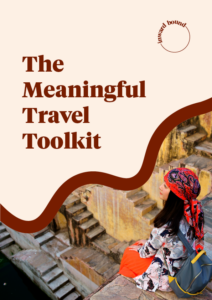
If you’d like a simple, practical companion to take on your next trip, our free Meaningful Travel Toolkit is a good place to start: a short set of practices to help any trip feel more alive, from the moment you arrive to the moment you come home.